
It Is All One Thing
On why the medium is not the act, and why the act is the same whether you are painting sunflowers, writing a children’s story, building a digital studio, or teaching a seventeen-year-old to finish wha

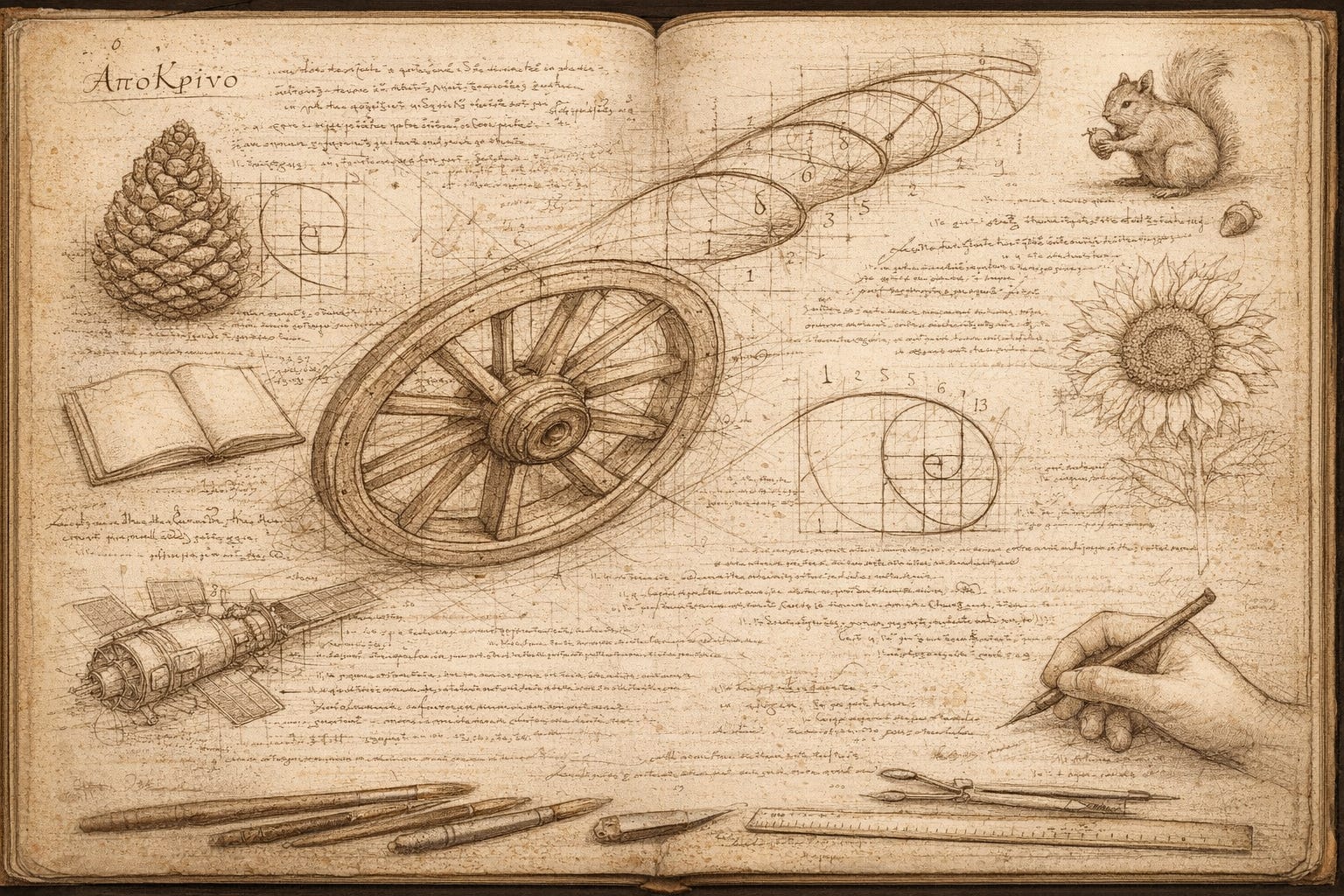
I don’t think in terms of the single inspiration. When I create, sometimes it is music, sometimes poetry, sometimes visual art, and the visual art can be of many media and types. I’ve done stage acting and improvisational theater. I’ve taught for twenty-six years. And somewhere along the way, through all of that, I have learned something I did not set out to learn: if you consider the center of the act to be a way of expression rather than the medium or the subject, it’s all a single act of mastery. What changes is the surface. What stays the same is the cycle underneath. This essay is about that cycle; it is about what happens when you recognize it across everything you make. It turns out to be the thing I have been teaching my whole working life without always having the words for it. We don’t always have the words and you have to learn to trust yourself. We do the work to earn that trust.
The act of externalizing internal experiences for sharing through art travels a distinct path. First you have to find a way to get it down — a sketchbook, a scrap of melody, a gesture, a color field. Whatever material will hold the first mark long enough for the next one to join it, that is the right medium. Then you need a focus — a metaphor, an object in a context, a refrain or a chorus, a compositional balance or imbalance that begins to frame the emotional state with a clear communication of what you’re referencing. Sometimes the reference is literal. Sometimes it is placed in a different context, the way a painter puts grief inside a still life and trusts the viewer to feel the grief before they name it. In that case, the emotion rests in color and intensity of brushstrokes, in the formal elements themselves. For certain felt experiences there are ready vessels waiting: a blues song for suffering, a painting of sunflowers for nameless joy. The vessel is not the feeling; we have to fill it. The vessel is what lets the feeling travel from inside one person to inside another, which is the whole reason anybody makes anything in the first place. We use the formats for what fits them. The forms persist as long as we need them.
Designs and inventions seem separate from this. They are not. They are solving problems similar to those solved by different types of art and in different ways— the problem of how to get something that exists inside a mind to exist outside a mind in a form other people can encounter—but they are solving problems of experience just the same. Design thinking gave me words for this but I did not find those until the middle of my career. In my case, I did not want an app that tried to solve creative problems the same way every other app does. So I built a new digital environment that gives me the experience I was looking for. I wanted to return to the same place with the same tools, not for predicatability alone but to solve bigger problems than I could solve before, to capture experiences of longer duration than a single session or series could hold. I wanted the year upon year to be a ladder, not a crutch. As I built it and began to use it, I realized something I had not realized with clarity as I was building it: I had recreated the experience of making art from my classroom. The digital environment was a studio, and the studio was a room I already knew by heart, and I had not known I was building that room until I walked into it the first time.
I remember the second year I taught from a digital learning paltform. Instead of spending the first weeks of school making copies and stapling packets of syllabi, I was iterating. I made edits. I redesigned lessons in small but powerful ways. I realized that if I did this every year, my learning would compound year after year. I didn’t just improve lessons, I reinvented them because suddenly I could feel and see the difference between what I thought I had designed and what I had actually built. This is one of the big lessons art has given me. It was odd to learn that experience applied not just to how I wrote and spoke about artists but how I thought about teaching itself. The pattern that should have been obvious in my imagination was staring me in the face.
That was when the sameness became unmistakable to me. My acts of creativity, across every medium I have worked in, is the art of reproducing experiences on an emotional register. Just as design thinking attempts to redesign the experience with empathy in mind, it is the feeling of the gift that matters to us more than what comes in the box; this is the lesson of mastery. And so I began to realize that art and design are equally acts of making and shaping the transmission of the feeling to the result. That is the act I have fallen in love with in all its forms — the painting, the poem, the song, the scene, the classroom, the software, the story about a squirrel in a forest. They are the same act. They are not similar acts. They are the same act performed with different materials in front of different audiences for different durations. The audience does not always know this. The maker, if they continue to pay attention, eventually does.
The craft of creative practice is a slightly different matter, and it is where I have fallen in love with a second thing, which is the leap of faith of beginning a line without clear inspiration. Choosing colors for a blank canvas in the absence of a clear intention. Sitting down to start a new writing project with a blank page and a blinking cursor and nothing else. This is the act of showing up to work, even when you don’t particularly feel like it, and especially when you most decidedly do not want to at all. These are the days when it matters perhaps most of all — the days when the only thing between you and a finished thing is the willingness to begin badly and let the beginning become something better the next day. We develop the ability to wait when we know we have the habit of showing up the next.
We tend to focus on the beginnings and endings of things. We stand at the door and wait for the wheel to start, and we stand at the door again and notice when the wheel stops, and we are surprised both times. I have learned to insist on holding to the center. That is what a wheel needs to remain in motion — not a hand on the first turn and not a hand on the last, but a steady attention to the middle where the turning is actually happening. If you try to control the ending you will not arrive anywhere new, because the ending you can control is only the ending you could already imagine, and the whole reason to make anything is to find out what you could not yet imagine. If you try to control the beginning, you will never learn to trust that you can find your way, and without that trust you cannot let the work take you anywhere worth going. The middle is where the trust lives. The middle is where the wheel turns.
But here is the thing about the wheel that I did not understand for a long time, and that I want to say carefully because it is the thing the whole essay has been circling toward. The wheel is not a circle. It looks like a circle from outside — as an abstraction viewed from above — and if you have only watched other people work you may believe that what they are doing is going around and around over the same ground. But from the inside, from the place where the work is actually happening, the wheel is a spiral. Every turn brings you back to the same tools and the same practices and the same act of showing up to the blank page — and every turn brings you back to them higher than you were the last time, because the you who is showing up today is not the you who showed up last year. The sketchbook is the same sketchbook. The hand is the same hand. The act of beginning is the same act. But the person doing the beginning has been changed by every previous beginning, and the beginning itself is therefore not the same beginning, even though it looks identical from the door when an observer walks by or even for the same artist when they walk through that door each morning. That is why the master and the novice can sit at the same blank page with the same pencil and produce completely different things. They are not at the same place on the spiral. They are standing at different heights, looking down at the same shape of the work, and the shape reveals different things depending on how much of the spiral each has already climbed.
This is why the craft matters. This is why the showing up matters. Every time you show up, the spiral rises a little, even on the days when nothing good happens and the work is terrible and you cannot see any progress. The progress is the rising itself. We stand equally upon success as the mounting pile of creative carnage. The rising happens whether or not you produce anything worth keeping on any given day, because the person who showed up and failed is a slightly different person than the one who will show up tomorrow, and the difference accumulates into the kind of mastery that looks, from the outside, like someone going in circles and, from the inside, like someone climbing a mountain one careful turn at a time. Work on the middle long enough — hold to the center and trust the act of the turning, keep returning to the same tools and the same practices with the willingness to be changed by them — and you can make many things with excellence. Regardless of the medium and regardless of the goal, the tools and the holding are the same. The spiral rises under your feet whether you notice or not. It is always better to try to notice.
The master is the one who has stayed with it all long enough to know the short cycles and the quick wins, the countless failures, and the long cycles when true beauty shows up like an old friend, because it is an old friend, and you both put in the time, and you agreed over the years on the right colors and the favorite brushes, and you keep trying new things to push a little further. The friend is the same friend each time. The meeting is new each time, because you are higher on the spiral than you were when you last met her. We leave the house because life is about the surprises. We put in the work so that when the surprises come we are ready to receive them. We climb the spiral one turn at a time because that is how the receiving gets deeper. As we sink deeper into craft, our reach paradoxically rises.
Recently, I have been pushing hard to nail down some big theories that have come into focus for me over the last two years — work about signal and node, about the way perception precedes classification, about the design cycle applied recursively to a creative life. But whether I am writing theory or allegories about squirrels and other animals in the forest for a children’s story, or guiding a student through a portfolio project or an engineering prototype or a series of paintings they have been trying to make for a year and have not yet been able to finish, it is all the same project. We are all learning, in our own ways, to process what goes on around us and to build the tools and the strategies to respond. That is why I chose to call my company and school ApoKrino. The word is Greek. It means the well-considered response. It is the thing the work is for. It is also the thing the work teaches.
So whether you come to me for art, or to invent better, or to do a project that gets you into engineering school, or because you want to spend time in a studio where you can learn to paint and make fine art — or because you watched a YouTube video about Artemis 2 and von Neumann probes last week and cannot stop thinking about it and your parents want to know what you are going to do with your life — it is the same work. It is the habits of noticing what is happening inside you, finding the vessel that can carry it outward, doing the work of making the vessel well, and staying with the practice long enough to meet the old friend when she comes to the door. And then beginning again, one turn higher than before, with the same tools and a slightly different self.
In this sense of mastery, it is all one thing. I have been teaching the one thing for twenty-six years. I did not always know that was what I was teaching. This is why we must learn to trust our creative selves. This is why we must do the work. We must learn it to earn it.
Trevett Allen is the founder of ApoKrino Studio and has been teaching creative practice across visual art, writing, performance, engineering, and design for twenty-six years. His students have been accepted to RISD, SAIC, Ringling, UPenn, Wesleyan, FIT and more, and have also become engineering team leaders and winners of national innovation challenges. He lives and works in southern Spain. The first international cohort of the ApoKrino Atelier begins Monday 8 June 2026. Free 30-minute discovery calls are available through the link in the bio. Creative software in MVP form at apokrino.com